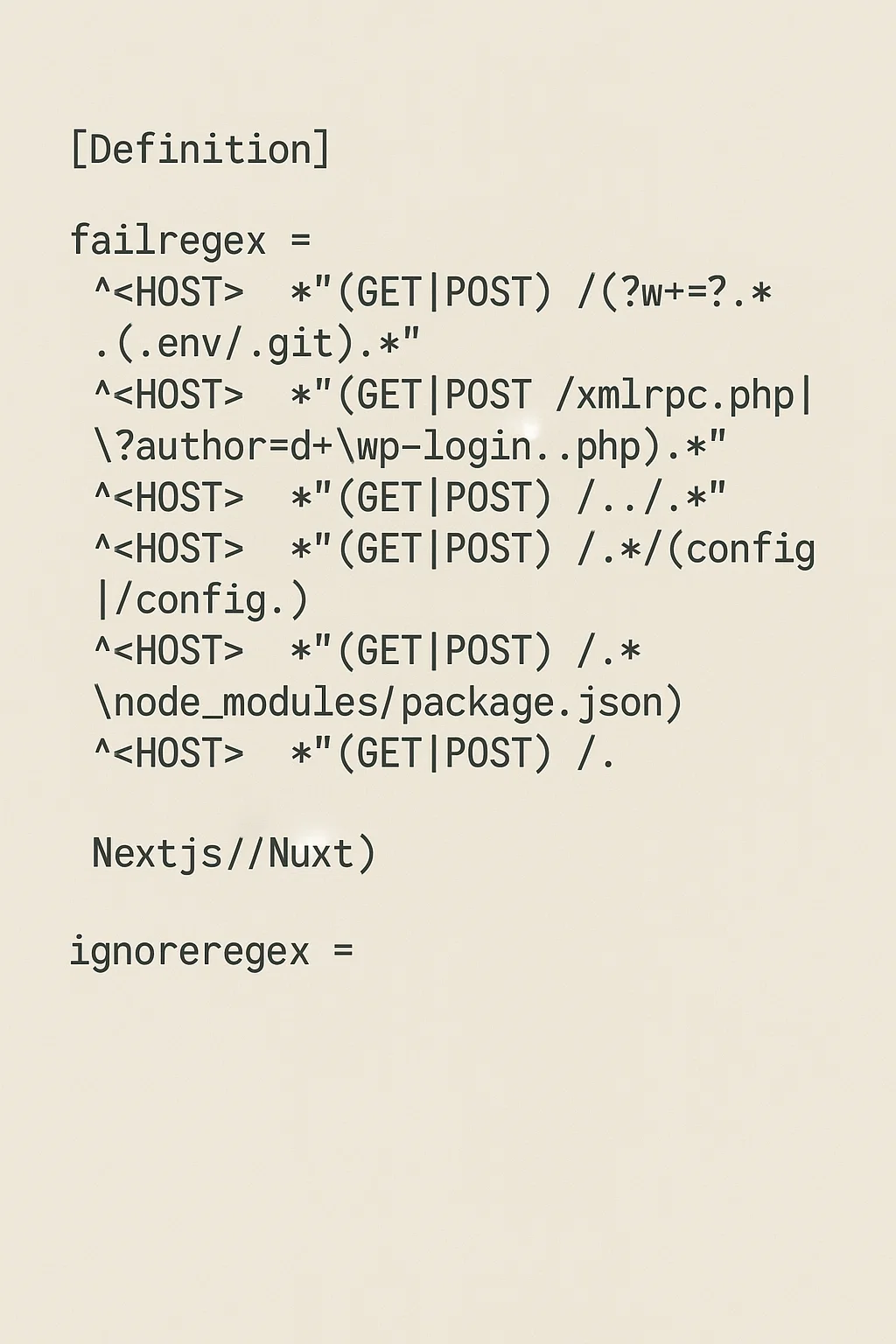
A Fail2Ban filter protect
Laravel, WordPress, and Node.js frameworks (Next.js/Nuxt) applications from common attacks, automated scans, and unauthorized access to sensitive files.
 ValentaizarHitsukaya
What this filter does
Protects sensitive files and configurations (.env, .git, .htaccess, artisan, etc.)
Blocks attempts to access Laravel debug and log tools (_debugbar, telescope, horizon)
Secures WordPress paths (wp-admin, wp-login.php, xmlrpc.php, wp-content)
Protects Node.js / Next.js / Nuxt frameworks (package-lock.json, yarn.lock, .next/, .nuxt/)
Detects dangerous uploads, backups, and database dumps
Prevents directory traversal, RCE, or injection attempts (?cmd=, ?exec=, etc.)
Blocks crawlers and automated scanners
Installation
1. Create the Fail2Ban filter
Save the filter content into a file, for example:
sudo nano /etc/fail2ban/filter.d/laravel-wordpress.conf[Definition]
# =========================
# Sensitive files & config
# =========================
failregex = ^<HOST> -.*"(GET|POST).*\.env.*HTTP.*"
^<HOST> -.*"(GET|POST).*\.env\.example.*HTTP.*"
^<HOST> -.*"(GET|POST).*\.git.*HTTP.*"
^<HOST> -.*"(GET|POST).*\.gitignore.*HTTP.*"
^<HOST> -.*"(GET|POST).*\.htaccess.*HTTP.*"
^<HOST> -.*"(GET|POST).*\.htpasswd.*HTTP.*"
^<HOST> -.*"(GET|POST).*artisan.*HTTP.*"
^<HOST> -.*"(GET|POST).*vendor/.*HTTP.*"
^<HOST> -.*"(GET|POST).*storage/.*HTTP.*"
^<HOST> -.*"(GET|POST).*bootstrap/.*HTTP.*"
^<HOST> -.*"(GET|POST).*config/.*HTTP.*"
^<HOST> -.*"(GET|POST).*package.*HTTP.*"
^<HOST> -.*"(GET|POST).*Dockerfile.*HTTP.*"
^<HOST> -.*"(GET|POST).*docker-compose.*HTTP.*"
^<HOST> -.*"(GET|POST).*webpack.*HTTP.*"
^<HOST> -.*"(GET|POST).*vite.*HTTP.*"
^<HOST> -.*"(GET|POST).*gulpfile.*HTTP.*"
# =========================
# Laravel debug & logs
# =========================
^<HOST> -.*"(GET|POST).*/_debugbar.*HTTP.*"
^<HOST> -.*"(GET|POST).*/telescope.*HTTP.*"
^<HOST> -.*"(GET|POST).*/horizon.*HTTP.*"
# =========================
# WordPress & CMS common paths
# =========================
^<HOST> -.*"(GET|POST).*wp-admin.*HTTP.*"
^<HOST> -.*"(GET|POST).*wp-login\.php.*HTTP.*"
^<HOST> -.*"(POST).*xmlrpc\.php.*HTTP.*"
^<HOST> -.*"(GET|POST).*setup-config\.php.*HTTP.*"
^<HOST> -.*"(GET|POST).*wordpress.*HTTP.*"
^<HOST> -.*"(GET|POST).*wp-json/.*HTTP.*"
^<HOST> -.*"(GET|POST).*/wp-content/.*\.php.*HTTP.*"
^<HOST> -.*"(GET|POST).*/wp-content/plugins/.*HTTP.*"
^<HOST> -.*"(GET|POST).*/phpmyadmin/.*HTTP.*"
^<HOST> -.*"(GET|POST).*/adminer\.php.*HTTP.*"
# =========================
# Node.js / Next.js / Nuxt
# =========================
^<HOST> -.*"(GET|POST).*next\.config\.js.*HTTP.*"
^<HOST> -.*"(GET|POST).*nuxt\.config\.js.*HTTP.*"
^<HOST> -.*"(GET|POST).*tsconfig\.json.*HTTP.*"
^<HOST> -.*"(GET|POST).*vue\.config\.js.*HTTP.*"
^<HOST> -.*"(GET|POST).*server\.js.*HTTP.*"
^<HOST> -.*"(GET|POST).*app\.js.*HTTP.*"
^<HOST> -.*"(GET|POST).*\.next/.*HTTP.*"
^<HOST> -.*"(GET|POST).*\.nuxt/.*HTTP.*"
^<HOST> -.*"(GET|POST).*package-lock\.json.*HTTP.*"
^<HOST> -.*"(GET|POST).*yarn\.lock.*HTTP.*"
^<HOST> -.*"(GET|POST).*pnpm-lock\.yaml.*HTTP.*"
^<HOST> -.*"(GET|POST).*/dist/.*HTTP.*"
^<HOST> -.*"(GET|POST).*/node_modules/.*HTTP.*"
# =========================
# Uploads / backup / temp / dumps
# =========================
^<HOST> -.*"(GET|POST).*/uploads/.*\.(php|php5|phtml|phar|asp|aspx|jsp|sh).*HTTP.*
^<HOST> -.*"(GET|POST).*\.(swp|swx|bak|old|orig|tmp|~).*HTTP.*
^<HOST> -.*"(GET|POST).*backup/.*HTTP.*"
^<HOST> -.*"(GET|POST).*dump\.sql.*HTTP.*"
^<HOST> -.*"(GET|POST).*database\.sql.*HTTP.*"
^<HOST> -.*"(GET|POST).*\.sql.*HTTP.*"
^<HOST> -.*"(GET|POST).*/uploads/.*\.(exe|dll|jar|py|rb).*HTTP.*"
# =========================
# Traversal / RCE / injection attempts
# =========================
^<HOST> -.*"(GET|POST).*\.\./.*HTTP.*
^<HOST> -.*"(GET|POST).*\?cmd=.*HTTP.*
^<HOST> -.*"(GET|POST).*\?exec=.*HTTP.*
^<HOST> -.*"(GET|POST).*\?shell=.*HTTP.*
^<HOST> -.*"(GET|POST).*\?ping=.*HTTP.*
^<HOST> -.*"(GET|POST).*\?run=.*HTTP.*
^<HOST> -.*"(POST).*/api/(login|auth).*HTTP.*
^<HOST> -.*"(POST).*/admin/login.*HTTP.*"
# =========================
# Crawlers / scanners / automated requests
# =========================
^<HOST> -.*"(GET|POST).*wp-admin/.*\.xml.*HTTP.*"
^<HOST> -.*"(GET|POST).*/\.git/.*HTTP.*"
^<HOST> -.*"(GET|POST).*/\.env/.*HTTP.*"
^<HOST> -.*"(GET|POST).*/\.htaccess/.*HTTP.*"
^<HOST> -.*"(GET|POST).*/favicon\.ico.*HTTP.*"
^<HOST> -.*"(GET|POST).*/robots\.txt.*HTTP.*"
^<HOST> -.*"(GET|POST).*/sitemap\.xml.*HTTP.*"
^<HOST> -.*"(GET|POST).*\.well-known/.*HTTP.*"
^<HOST> -.*"(GET|POST).*acme-challenge.*HTTP.*"
# =========================
# FastCGI Primary script unknown
# =========================
^.*FastCGI sent in stderr: "Primary script unknown" while reading response header from upstream, client: <HOST>.*, request: ".*"
ignoreregex =
# =========================
# Ignored regex (legit crawlers / SSL noise)
# =========================
#ignoreregex = .*Googlebot.*|.*bingbot.*|.*DuckDuckBot.*|.*Baiduspider.*|.*SSL_do_handshake.*|.*bad certificate.*|.*no shared cipher.*|.*connection reset by peer.*
2. Create the jail
Create or edit a local jail configuration:
sudo nano /etc/fail2ban/jail.d/laravel-wordpress.local[laravel-wordpress]
enabled = true
port = http,https
filter = laravel-wordpress
logpath = /var/log/nginx/access.log /var/log/nginx/error.log
maxretry = 1
bantime = -1
banaction = iptables-multiport
findtime = 600
ignoreip = 127.0.0.1/8 ::1 <YOUR-IP-HERE>
persistent = trueReplace with your IP to avoid accidentally banning yourself.
3. Test the filter
sudo fail2ban-client reload
sudo fail2ban-client status laravel-wordpress
Recommended settings
bantime = -1 → permanently ban attackers
maxretry = 1 → block on the first suspicious attempt
findtime = 600 → 10-minute detection window
ignoreip → include your IP and other admin IPs
Example of detected logs
192.168.1.100 - - [16/Sep/2025:09:00:01 +0300] "GET /.env HTTP/1.1" 404 162 "-" "curl/7.68.0"
203.0.113.45 - - [16/Sep/2025:09:05:12 +0300] "POST /wp-login.php HTTP/1.1" 404 245 "-" "Mozilla/5.0"
Recommended OS: RHEL-based distributions